
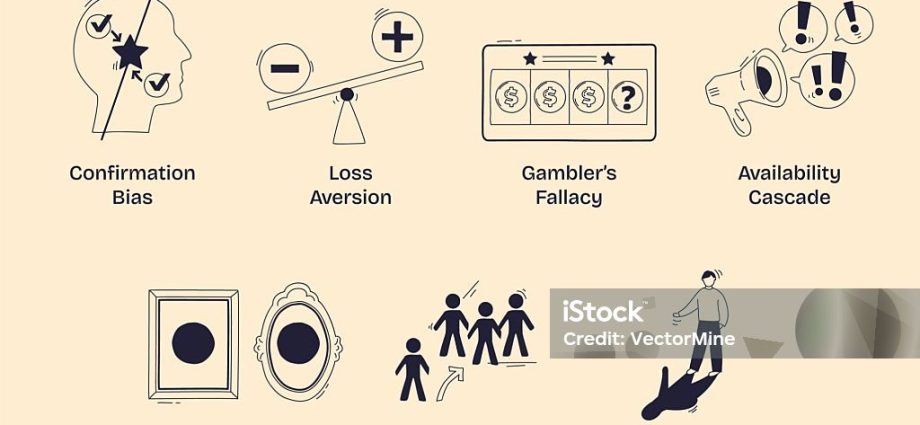

Let’s be honest—uncertainty is the default setting of life. We rarely get clean probabilities handed to us on a silver platter. Instead, we’re left guessing, pattern-matching, and hoping. And that’s precisely where our brains start playing tricks on us. Cognitive biases are like mental shortcuts that misfire, especially when the outcome is foggy. They’re not just academic curiosities; they shape your career moves, your investments, even who you date. So, let’s pull back the curtain on these invisible puppeteers.
The Anchoring Effect: The First Number Wins
Ever notice how a sale price feels like a steal—until you realize the original price was inflated? That’s anchoring. Your brain latches onto the first piece of information and judges everything else against it. In uncertain situations, this is dangerous because the anchor might be totally arbitrary.
Say you’re negotiating a salary. The first offer, even if it’s low, becomes your reference point. Suddenly, a modest bump feels like a victory. But what if you’d anchored higher? The bias doesn’t just skew numbers; it skews your perception of what’s possible. In financial markets, analysts often anchor to a stock’s 52-week high, even when the fundamentals have changed completely. The result? They hold onto losing positions, waiting for a rebound that may never come.
Key takeaway: When facing uncertainty, ask yourself: “What would I think if I had no prior reference point?” Force yourself to reset.
Availability Heuristic: The Loudest Memory Wins
Here’s the deal—your brain weights information by how easily it comes to mind, not by how accurate it is. That’s the availability heuristic. After a plane crash makes headlines, people suddenly fear flying, even though car accidents are far more common. The vivid, dramatic memory overshadows the statistical truth.
In uncertain outcomes, this bias is a silent killer. Think about the entrepreneur who overestimates startup success because they just read a viral story about a unicorn. They ignore the 90% failure rate because those failures don’t make headlines. The fix? Actively seek out base rates—the actual, boring statistics. It’s not glamorous, but it’s real.
Confirmation Bias: The Echo Chamber in Your Head
Well, this one’s a classic. Confirmation bias is when you filter out evidence that contradicts what you already believe. It’s like having a personal assistant who only shows you the news you agree with. In uncertain situations, this becomes a trap because you’re not actually evaluating the situation—you’re just validating your existing hunch.
Imagine you’re deciding whether to quit your job and freelance. You’ll notice every success story, every post about “financial freedom,” and conveniently gloss over the ones about burnout and inconsistent income. Your brain isn’t being malicious—it’s just lazy. It prefers comfort over cognitive dissonance.
Pro tip: Deliberately argue the opposite side. Write down three reasons your decision could fail. If you can’t think of any, that’s a red flag.
Overconfidence Bias: The Illusion of Control
Honestly, we all think we’re above average drivers. That’s overconfidence bias in a nutshell. It gets worse when outcomes are uncertain because we mistake our ability to predict for actual control over the situation. The stock market is a perfect playground for this. People day-trade like they have a crystal ball, ignoring the fact that most professional fund managers can’t beat the index over time.
There’s a subtle difference between confidence and overconfidence. Confidence is “I’ve prepared well.” Overconfidence is “I know exactly how this will play out.” The latter is a fantasy. When you feel that surge of certainty, step back. Remind yourself that the world is full of black swans—unpredictable events that upend all your models.
Loss Aversion: Why Losing Hurts More Than Winning Feels Good
Here’s a quirk: losing $100 feels roughly twice as painful as gaining $100 feels pleasurable. That’s loss aversion, and it’s wired deep into our psychology. In uncertain outcomes, this bias makes us overly conservative. We’d rather avoid a potential loss than pursue a larger gain. It’s why people hold onto losing stocks—selling would “lock in” the loss, which feels like a personal failure.
But here’s the kicker: avoiding losses can be the biggest loss of all. Opportunity cost is invisible, so we ignore it. The safe path feels good in the moment, but it might be the riskiest path in the long run.
The Sunk Cost Fallacy: Throwing Good Money After Bad
This one’s personal. You’ve probably stayed in a relationship or a project way past its expiration date, just because you’d already invested so much time. That’s the sunk cost fallacy. The rational approach would be to ignore past investments—they’re gone—and only consider future costs and benefits. But humans are sentimental creatures.
In business, this shows up as continuing to fund a failing product because “we’ve already spent millions on R&D.” That money is gone. The real question is: “What’s the best use of resources from this point forward?” It’s brutal, but it’s necessary.
Herd Mentality: Safety in Numbers (Even When Numbers Are Wrong)
You know that feeling when everyone’s buying Bitcoin, and you start to think maybe you should too? That’s herd mentality. It’s a survival instinct gone haywire. In uncertain times, we look to others for cues on how to behave. If everyone’s panicking, we panic. If everyone’s buying, we buy. The problem? The herd is often wrong—especially in markets.
Think about the dot-com bubble. Everyone was piling into internet stocks, assuming the crowd knew something they didn’t. The crowd didn’t. They were just as clueless, but collectively delusional. When you feel the pull to follow the crowd, pause. Ask yourself: “What do I actually know, versus what am I assuming because others are doing it?”
Recency Bias: The Tyranny of the Now
Recency bias is the tendency to overweigh recent events over long-term patterns. After a hot market year, people expect it to continue. After a crash, they expect doom. It’s like judging a movie by its last five minutes. In uncertain outcomes, this bias makes you reactive instead of strategic.
A classic example is in hiring. A candidate who just gave a great interview gets the job, even if their track record is mediocre. The recent impression clouds the bigger picture. The antidote? Force yourself to look at the full timeline, not just the latest chapter.
Practical Strategies to Counteract These Biases
Okay, so we’ve painted a grim picture of the human mind. But here’s the good news: awareness is half the battle. You can’t eliminate biases, but you can build systems to catch them. Here are a few tactics that actually work:
- Use pre-mortems: Before making a big decision, imagine it failed spectacularly. Write down why it failed. This forces you to consider risks you’d otherwise ignore.
- Seek disconfirming evidence: Actively look for information that contradicts your belief. It feels uncomfortable, but that’s the point.
- Delay decisions: If you’re emotionally charged, wait 24 hours. Biases thrive on impulse.
- Create decision checklists: Write down your assumptions and then question each one. Are you anchoring? Herding? Being overconfident?
- Embrace probabilistic thinking: Instead of “this will work” or “this will fail,” think in percentages. “There’s a 60% chance this works, and here’s what I’ll do if it doesn’t.”
The Role of Emotion in Uncertainty
Let’s not pretend we’re Vulcans. Emotion is always in the driver’s seat, even when we think logic is steering. Fear amplifies loss aversion. Excitement fuels overconfidence. Anxiety triggers herd behavior. The trick isn’t to suppress emotion—that’s impossible. It’s to recognize when your emotional state is distorting your judgment.
One trick: label the emotion. Say to yourself, “I’m feeling anxious, and that’s making me want to sell.” Just naming the feeling reduces its grip on your reasoning. It’s a small move, but it creates a sliver of distance between you and your impulse.
When Biases Actually Help
Not all biases are bad. In fact, some exist for good reason. Heuristics—the mental shortcuts—are essential for fast decision-making. If you had to analyze every single variable in every situation, you’d freeze. Sometimes, gut instinct is the best tool you have, especially in familiar environments.
The key is knowing when to trust the gut and when to engage the logical brain. If you’re in a high-stakes, unfamiliar situation, slow down. If you’re in a low-stakes, repetitive scenario, go with the flow. The danger isn’t having biases—it’s being blind to them.
A Final Thought on Uncertainty
Uncertainty is uncomfortable. We crave closure, clarity, and control. But the uncomfortable truth is that we’re often operating with incomplete information. The best you can do is acknowledge your cognitive limits and build a little humility into your decision-making. You’re not going to outsmart every bias—that’s not the goal. The goal is to make fewer, smaller mistakes over time.
So the next time you’re staring at an uncertain outcome, remember: your brain is a brilliant storyteller, but it’s also a notorious liar. Question the narrative. Check the data. And for goodness’ sake, don’t trust the crowd just because they’re all moving in the same direction.
Because in the end, judgment isn’t about being right all the time. It’s about being less wrong than you were yesterday.